
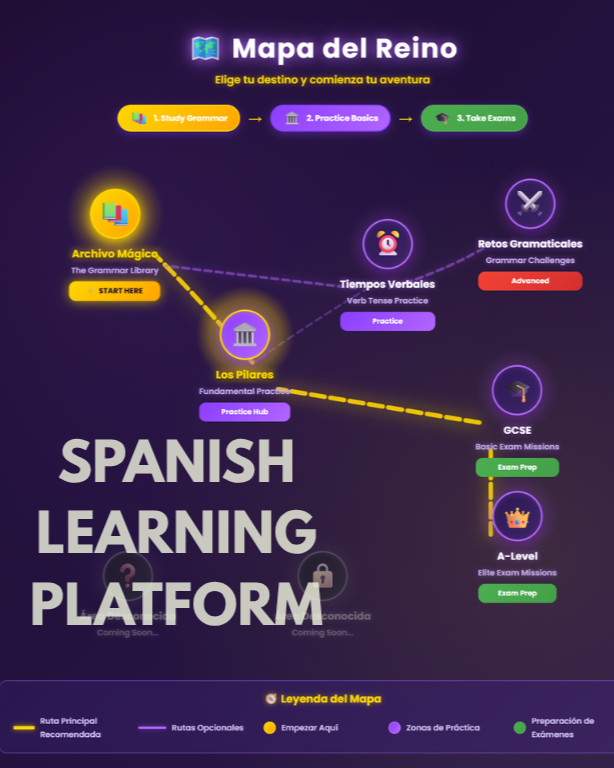
Mapa del Reino = Kingdom’s Map
Let me start this introduction by saying: in 2023 I uploaded over 800 TikTok videos.
Sí, you read that right. Eight hundred. Ochocientos. Videos. That was 1 to 3 videos every single day for an entire year with no days off, it was the challenge I decided to do in 2023. Grammar explanations, vocabulary tests, verb conjugations… Anything that I could do in order to help my students practise and learn more Spanish outside of our classes.
And by the end of it? I was completely burnt out.
But those 800+ videos taught me many things. Not about Spanish, but about what students actually need. That realisation led me to spend months thinking about what could I build to teach Spanish where grammar doesn’t feel like an annoying task, or homework and practise actually feels like… fun?
This is the story of how I went from exhausted content creator to amateur… “game developer” (?), I don’t think I should call myself that to be honest, and why I’m still convinced this was the right decision, even after the hundredth coding error at 2am.
PART 1: THE PROBLEM I COULDN’T IGNORE
I’ve been teaching Spanish since February 2019, privately at first, then I joined for four years as a Spanish Assistant in a UK secondary school (Y7s-Y13s) in 2021. Over those seven years, I’ve worked with hundreds of students preparing for GCSE and A-Level Spanish, and also students of all ages wanting to be fluent in Spanish for their own reasons. No matter how engaging I made my lessons, no matter how many resources I created, I kept running into the same problem:
Students struggled to practise outside of class.
They would leave our sessions motivated, understanding the grammar, nailing the pronunciation… But then life happened. Homework piled up. Other subjects demanded attention. Family. Work. Lack of free time. Meanwhile Spanish got pushed aside until the night before our next lesson.
I tried things like:
Worksheets? They would arrive with them half done or not done at all.
Textbook exercises? The same as before.
Online resources? “I couldn’t find the right topic, or I didn’t understand the grammar” … “My dog ate the website”
YouTube videos? I got distracted watching other videos.
I had one student that genuinely wanted to improve her Spanish, but she was so busy with her work, even working during weekends, that it wasn’t motivation what she was lacking, but free time to actually sit down and revise or do her homework, as when she was free she would go to the gym, cook, clean the house or just a very needed siesta.
Another student was really motivated during the classes, would do everything and more to make the most of the one hour long weekly class we had, but the homework… the homework was existent but non-existent, if you get what I mean.
I would love to say this next example was just one student, but it’s getting worse and worse and more are doing this, let me explain:
I send a specific exercise to do, let’s say an essay, summary, even a reading comprehension, and it comes back with absolutely no mistakes at all, perfect grammar, accent marks, even words that Spanish native speakers wouldn’t use, but somehow the non-native student knows exactly how and when to use them. But as the teacher, you know that if they were to do the same exercise on the spot, the result would be slightly or very different depending on the case. So when I ask and get to the root, the answer is clear “I used some help from AI or translators”.
If the student is preparing for GCSE or A-Level, as the teacher, this doesn’t help me at all. I don’t care about the grade per se, if the exercise comes back perfect every single time, then I don’t know where would the student fail in the actual exam, so we can’t improve the weaknesses and make sure the strengths are kept on check.
I need to see the mistakes that would naturally happen with someone learning a new language.
The pattern was clear after a while, traditional practise methods weren’t working. Not because students didn’t want to improve, they did. But because studying Spanish felt like a chore, not an adventure.
PART 2: THE TIKTOK EXPERIMENT (800+ VIDEOS OF MADNESS)
So just before 2023 started, I thought on the idea of meeting my students where they already were, not in textbooks, but on social media.
I had been doing social media posts since I started the business in 2019 but very on and off as I was focused on preparing and teaching Spanish classes, and also on the side ZUMBA® classes. I didn’t really have the time nor the energy to create content regularly.
I was working 3 days at my school, and the other days I was teaching my private lessons, but Monday mornings were free, so I decided this was the moment were I had to record all the videos for the week. At least seven videos were prepared and recorded every Monday morning, usually between fourteen and twenty, as I mentioned, I wanted to upload one to three videos a day.
I started posting daily. Short Spanish lessons, common mistakes, vocabulary tests, grammar, verb conjugation, one daily curiosity from that book (if you know, you know). People were enjoying the content, the comments were really positive and it made me enjoy the side hassle of creating content not just for my students, but for anyone learning Spanish.
By the end of the year, I had created over 800 videos and gotten to almost 15k followers in TikTok.
And I was exhausted.
I remember most of December I just uploaded the daily curiosity from that 365 Curiosities book, not because I didn’t know what to make videos of, but because I was absolutely exhausted from editing and uploading that amount of videos daily for the entire year on my little free time outside of work.
Don’t get me wrong, those videos helped people and they even helped me. I’d get messages from students or random followers saying they smashed their exams, improved their Spanish, or understood things they never did before thanks to my videos. It felt incredible because that was my main goal when creating content, helping people understand and learn Spanish.
But there was a massive problem: the content was chaos.
Imagine you’re a student who needs help with the Pretérito Perfecto Simple. You would have to scroll through hundreds of my videos hoping to find the right one. Maybe you would find my video on Pretérito from January. Or was it March? Oh wait, I did three different videos on Pretérito, which one explains what you actually need?
The content was helpful, but the organisation was terrible. As a teacher, I couldn’t stop the feeling that I was just throwing information into the void rather than creating a real learning journey.
Start of 2024, time passed, I stopped creating content not only because of being tired of it after 2023, but also this feeling I just mentioned. I wanted something more organised.
Then in summer 2025 my school closed down. No warnings. No signs. I was in the middle of an English Summer Camp teaching English to almost 80 children from Chile at the school when we received the news. Chaos.
Suddenly, after the camp was over, I had time to think. Really think about what I wanted to do and build next.
PART 3: THE IDEA THAT WOULDN’T LEAVE ME ALONE
I always had a website, www.avaspanish.com , but honestly? It was pretty basic. Just a landing page with some information, a way to book my Spanish or ZUMBA® classes, and pretty much that was it. Functional, but forgettable, and I didn’t really have the knowledge to improve it nor the time to learn.
With the school closure giving me a fresh start, I decided to completely revamp it. I wanted a new logo, new colour palette. New vision overall.
But more importantly, I wanted to solve that organisation problem that had plagued my TikTok content.
What if I could create a structured learning platform where:
Grammar wasn’t scattered across over 800 random videos.
Students could find exactly what they needed instantly.
Practise exercises were organised by topic, difficulty and exam level.
Progress was tracked automatically.
Learning felt engaging, not tedious.
And here’s where my love of videogames and RPG-story based manhwas came in.
I’ve always loved RPGs, role-playing games where you level up, complete quests, earn rewards, and gradually become more powerful. There’s something deeply satisfying about that progression system. You start weak, practise, improve, and eventually, feel accomplished and realise all that hard work paid off.
What if learning Spanish felt like that?
What if the structure, the progression, the sense of achievement from RPGs could make grammar practise feel less like homework and more like… levelling up?
That’s when the idea hit me: what if I try to build an RPG-themed Spanish learning platform right into my website?
I hated and loved my brain for this. Let me remind you I had no knowledge on coding, just a little on website design because of having my own one for many years. Annoyingly, I also knew that as soon as the idea was in my brain, I had to at least try to make something with it. I knew I could not let go, because it would solve the issue of content organisation and also it would force me to learn new skills and improve my website overall. I was terrified and excited, in the end, the adrenaline took over.
PART 4: BUILDING “THE THING”. SLEEP? WHO NEEDS THAT
Here is the part where I should state yet again, just as a reminder: I’m not a developer.
I’m a Spanish teacher who also teaches ZUMBA®. I can conjugate verbs in my sleep and learn a choreography in ten minutes, but code? That was new, uncharted territory.
But I had already decided this was happening, so I did what any reasonable person con los pies en la tierra y dos dedos de frente would do: I dove in headfirst and learnt as I went.
The First Exercise: Presente de Indicativo - Fill The Gap Exercise
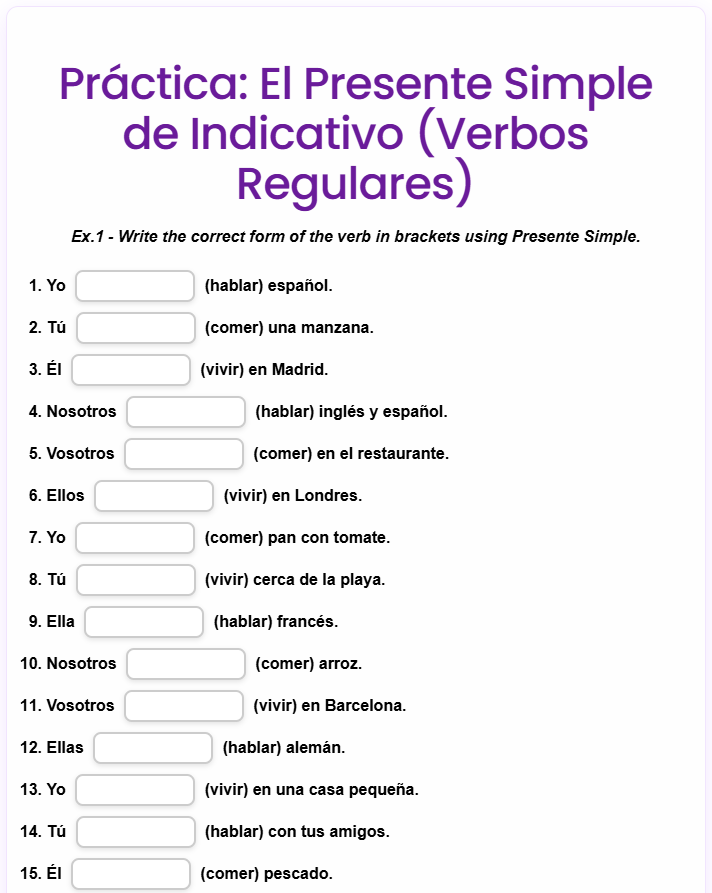
Photo Sample of how it looks currently (31/03/2026) The originals were quite different!
After trying to understand as much as I could of Custom CSS, HTML and JavaScript for what I wanted, I didn’t need any extra drama in what already was a chaotic “¿por qué narices me he metido en este fregado?”. The first exercise created for the platform side of the website was the Presente de Indicativo - Fill The Gap. Having the skeleton code for an exercise like this, I could just re-use it for all sorts of different fill the gap exercises, which is what I did. I created a Fill The Gap exercise for all the verb tenses for the Modo Indicativo and Modo Subjuntivo first.
I mean… coding is the language of computers, right? I want to believe I’m good with languages so… I should be okay, right? RIGHT?
Well, the amount of mistakes I had at first, let alone trying to connect all the exercises into one system that gives you xp to level up, and of course the future Álvaro also added the gold system because why not?
I can’t put into words the whole process, sleepless nights, and the amount of times I had to restart all until it was actually connected and working, and even then I had to restart more times after that with the addition of other stuff. Which made me want to save every single code (thank you Visual Studio Code, Notepads and even Google Docs) in case I messed up for the millionth time, at least I had the codes saved to copy and paste them. But I should point out that this didn’t happen until many (like seriously, many) fails and even breaking the whole website somehow multiple times. I learnt the hard way that a single full stop or comma in the wrong place will break an entire code, and if you don’t even know where the mistake is, good luck finding it in long codes.
Surprisingly, for my very “estoy perdiendo mi cabeza a niveles que no me podía ni imaginar” mood, I was somehow enjoying it. Not enjoying it in a way of “Oh! I found my new passion and I should totally change my entire career to this!” type of thing. But slowly building up the exercises and seeing they worked, the auto-correction, the total % given after click “Correct” and receiving your rewards depending on how well you did. Also the fact that it was for my website, I was making it for myself and my students, I didn’t really care how “professional” it was or looked, as long as it matched my vibe and what I wanted to accomplish with it.
All of this made me actually enjoy this very painful skill that I never thought I would even attempt to learn called “Coding”. Before I continue I have to say, if any of you reading this is a coder, you’re my absolute hero, you guys… I just want to give you all a hug, un abrazo muy grande.
The Foundation: Archivo Mágico
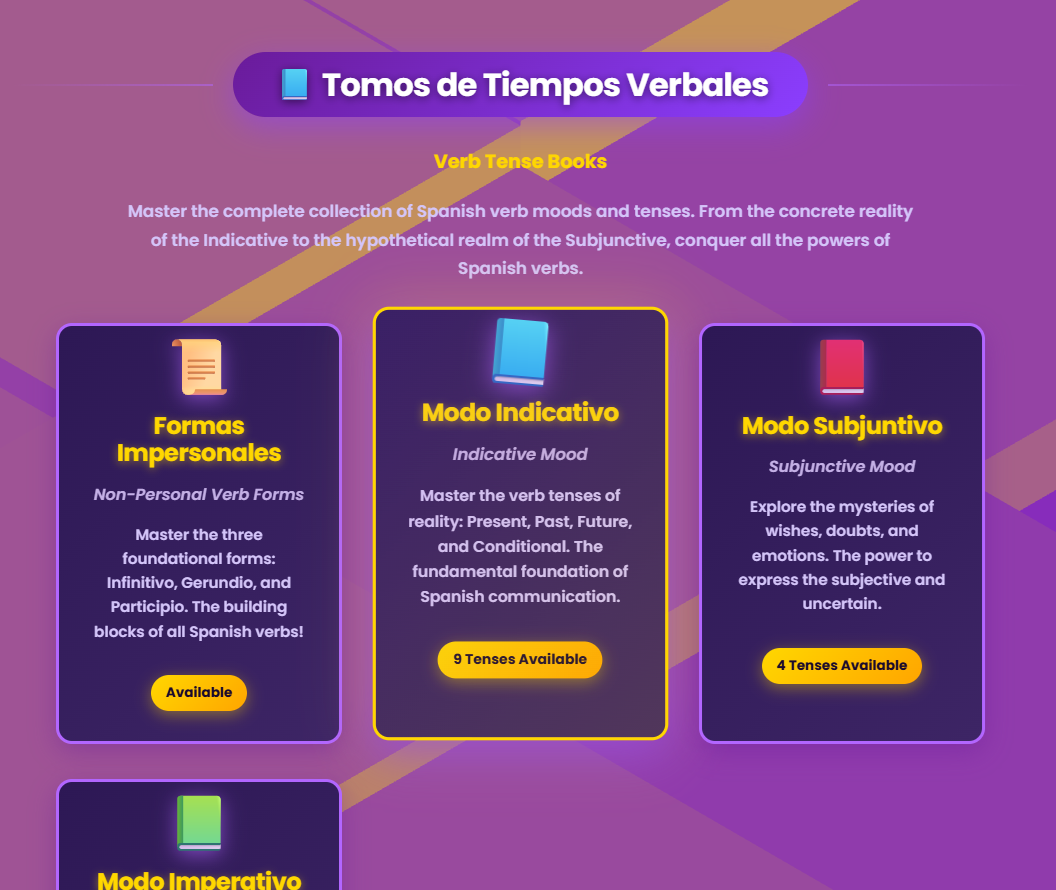
Verb Tenses in Archivo Mágico - Lots more to find there and lots more to come!
Exercises, exerices and exercises, but… where is the grammar? ¿¿¿DÓNDE ESTÁ LA GRAMÁTICA, ÁLVARO???
I needed to build something like a library, therefore and going on with the RPG themed base, I created the Archivo Mágico (Magic Archive - The Grammar Library). Essentially, a comprehensive grammar library where everything is organised by categories. All the Spanish verb moods (Indicativo, Subjuntivo, Imperativo), fundamental concepts like numbers, gender, articles, nouns… and tricky grammar battles like “por vs para”, “imperfecto vs perfecto simple”, “ser vs estar”… Everything explained with an adventure theme base.
This was crucial. Before students could practise, they needed a reference point. A place to learn (or revise / re-learn) the grammar before testing themselves.
I wanted it structured and clear. No more “where is the video explaining that rule about subjunctive?”. Everything is one place, properly categorised.
The Quest Map
I didn’t want a list of “Exercise 1, Exercise 2, Exercise 3…”. Remember, I was going for RPG vibes. So I wanted an adventure map, this is why “The Quest Map” was created.
A visual interface where students choose their challenge. Do you want to practise verb tenses? That’s a quest. Need to work on grammar challenges? Another quest. Are you doing Spanish GCSE or A-Level? Well, those are also quests. The map is also where you find El Archivo Mágico. Currently there are over 60 exercises covering GCSE, A-Level and general Spanish grammar.
Each exercise you complete? You earn XP and gold.
Level up your Spanish, quite literally.
The Hardest Part: Translation Exercises
Here is where things got… interesting (somehow even more).
Most of my exercises are Fill in the Gap, you see a sentence with a blank, you fill it in. These are straightforward to code, there is usually one correct answer.
But I wanted to add translation exercises as an extra challenge to practise more. Below each Fill The Gap exercise, students could try translating the full sentences from the exercise into English. Sounds simple, right?
It was an absolute nightmare.
Because in translation, there are multiple correct answers. Think about it:
- I was not there = I wasn’t there
- He does not know = He doesn’t know
- She is going to eat = She’s going to eat
- We will walk = We’ll walk
Let me give you a juicy one from the Pretérito Perfecto Compuesto exercise:
- Yo he hablado con mi madre hoy = ["I have spoken with my mother today", "I have talked with my mother today", "I've spoken with my mother today", "I've talked with my mother today", "I have spoken with my mum today", "I have talked with my mum today", "I've spoken with my mum today", "I've talked with my mum today", "I have spoken with my mom today", "I have talked with my mom today", "I've spoken with my mom today", "I've talked with my mom today"] - please don’t tell me I’ve missed an option unless you want me to cry.
Every single sentence needed every possible correct variation coded in. Otherwise, students would get marked wrong for writing something completely correct just because it wasn’t the exact phrasing I had anticipated.
I spent hours, HORAS, on single sentences, trying to think of every possible correct English translation. Testing them. Fixing them. Making my students, friends and partner do the exercises (I would have also made my dog do them if he could), so they could let me know if they had any issues with the translations, the more different brains doing the exercise, the better, that way I could add every possible answer as long as it was grammatically correct. So I ended up finding out I missed three more variations in one example, two more in another. Fixing them. Creating new bugs in the process. Fixing them.
To my partner at 9:30pm: “Oh I will be 10 minutes and I will head to bed, I want to finish this exercise code” … *3:00am* Okay bug number 55 fixed, I can finally go to bed, I’ve got to teach in the morning.
I genuinely almost gave up multiple nights at around that time questioning my life choices because like most of you, I do like to sleep, but I didn’t have any other time unless I spent the weekends (which I did anyway) doing the codes. Why was I doing this? Why not just find and use existing platforms? Why torture myself with code I barely understood?
I had a combination of feelings; frustration, determination, satisfaction, fury…
But the trait some of my closest people use to describe me, actually became the most important one in this craziness: stubborn. To a certain extend, I have to agree with them, I am stubborn, un cabezón de mucho cuidado. But thanks to that stubbornness I kept on going.
Every time I thought about quitting, I would remember this is what my students need. Structure, challenge, engagement, progress they can see. Also, this was now a personal challenge, I was challenging myself to do it. So I kept going.
The Features That Made It Special
As I built, I kept adding features I knew would matter and I wanted players to have:
- El Léxico del Reino (The Kingdom’s Lexicon). A vocabulary collection system, like a Pokédex (Nintendo, don’t come for me pls), but for Spanish words. Over 200 words so far with Spanish and English translations. Gender indicators so students know if a word is masculine or feminine, and a sentence example. Students can “collect” words by purchasing them from the shop with the gold they earn from doing exercises.
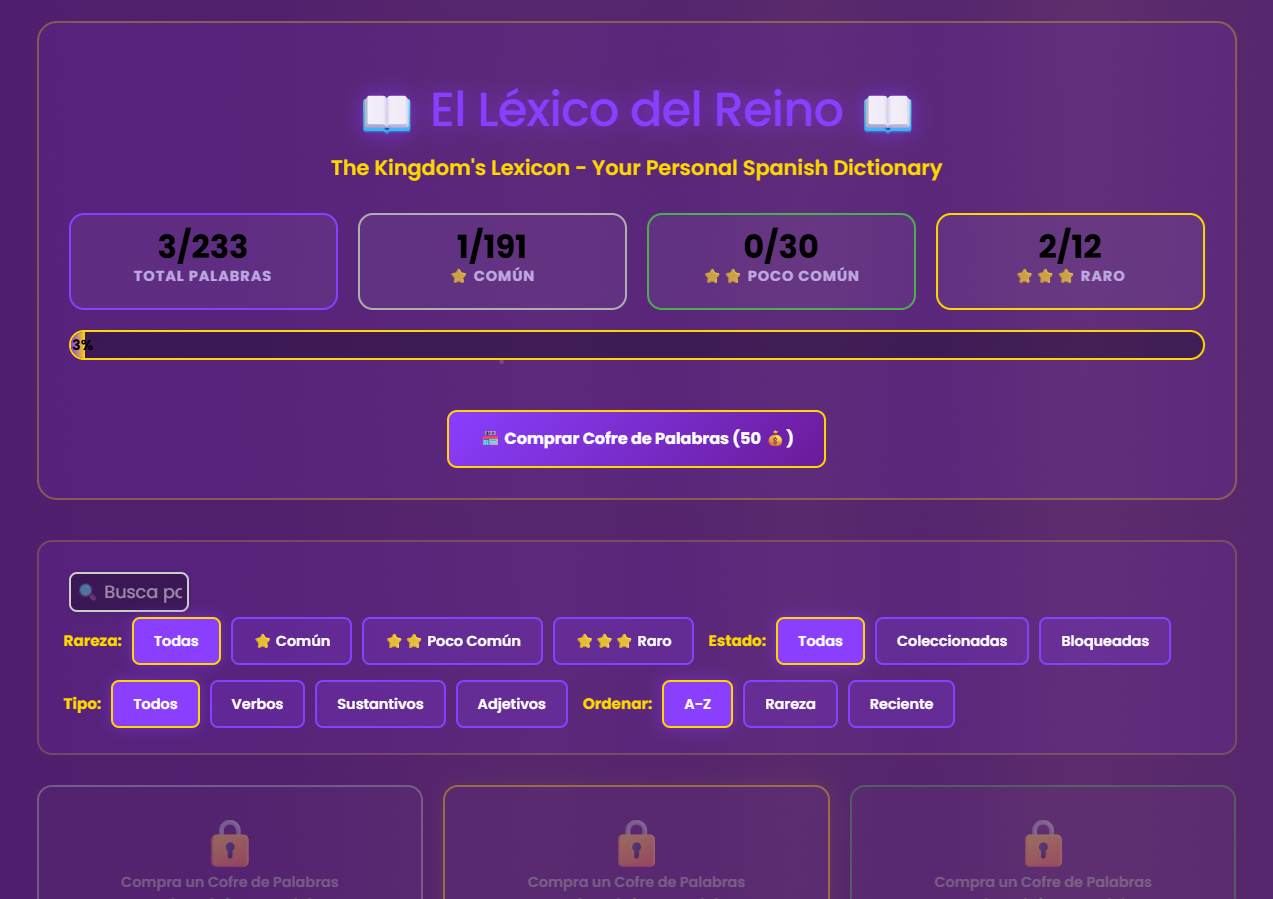
Many words to collect!
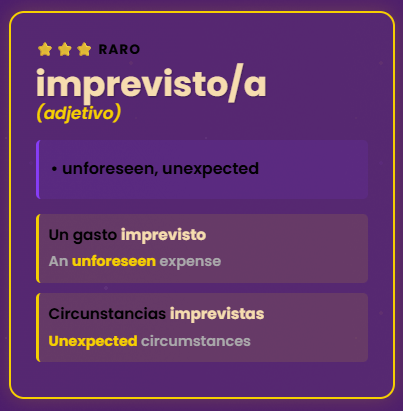
Example of how each word looks.
- Streak tracking. Because consistency matters. Miss a day? Your streak resets. Maintain a 7-day streak? You get a celebration animation and milestone rewards. You will have to maintain your streak for longer if you want to see more surprises (Evil Álvaro: Jejejejejejejeje)
- Cross-device sync. Start on your laptop, continue on your phone. Your progress follows you everywhere using Supabase backend integration.
- Leaderboards. A bit of friendly competition never hurt anyone, and I know some of you REALLY like competition…
- The Shop. Spend your hard earned gold from the exercises on… well, more content! Items to gain more xp, more gold, words for your Léxico del Reino and more! (and lots more to come)
All of it themed. All of it purple and gold (mainly). All of it designed to make Spanish feel less like studying and more like progressing through a game you actually want to play.
PART 5: THE “WHY IT’S FREE” QUESTION
Some people and students have asked me this: “Why is it free?”
Fair question, which I myself ask sometimes. I’ve spent months building this. Hundreds of hours with the codes, testing, fixing bugs, breaking the website, fixing it again, creating content… Why not charge for it?
Here’s the thing, I didn’t build this to gatekeep Spanish behind a paywall.
I built it because I saw students struggling to practise outside of lessons. Because I saw talented, motivated learners giving up, not because Spanish was too hard, but because traditional practise methods were boring for them.
Also, there are lots of free platforms already to learn and practise Spanish, and many other paid platforms too.
Yes, I offer paid tutoring. Yes, I run ZUMBA® classes. Those services have value and I charge accordingly.
But this platform? This is my way of saying: if you want to learn Spanish, cost shouldn’t be your barrier.
Maybe you can’t afford a tutor right now. Maybe your school’s Spanish resources are limited. Maybe you just want to explore the language before committing to paid lessons.
That’s fine. The platform is here for you. For free.
But for future ideas where I will need a professional to help me, my plan is to have 3 different tier Patreon in case any of the players want to support me to improve the platform. This hasn’t be done yet (13/03/2026, not even now 31/03/2026 when I finally finished writing all of this) but I will soon. This will not be mandatory though, fully optional and only if you actually enjoy the platform and find it useful. If interested my Patreon is: https://www.patreon.com/avaspanish
PART 6: WHAT I LEARNT (AND WHAT’S NEXT)
All the videos I published and building this platform taught me a couple of things:
Students crave structure more than they crave content.
I created so many videos thinking “more content = more learning”. But when the entire system is designed around progression, achievement, and visible improvement? That actually motivates people. And for my own mental health: organización y no caos.
Gamification works.
I have many other ideas I want to add into the platform, different ways to practise the same stuff, so people have a diversity of exercises to do with their favourite ones, so if one day the student is tired, they can quickly do one of their favourite exercises and call it a day. Remember, this is a marathon, not a sprint. With a gamified platform, you can see your progress over time and feel accomplished.Building something is humbling.
I had to repeat myself multiple times throughout this process “I’m a teacher learning to code, not a coder learning to teach”. My strength is understanding what students need, then figuring out how to build it. This has definitely make me appreciate the work of developers and coders to a level I couldn’t imagine.“Done” / “Finished” / “Perfection” are all a myth.
I always had a problem with “perfection” because I strive for it, but I also have to admit that I’m not a professional photographer, videographer, coder, developer, marketer… Before the platform, this issue was with the content creation, I always wanted the “perfect” video, otherwise I wouldn’t upload it. I got to a point where I was angry at myself with that idea, because I always found areas to improve. But in the end, as long as I was helping students somehow, it didn’t matter that the light wasn’t great, or even the audio, the cuts, the special effects, none of that mattered as long as the message was understood by the students for them to learn. I will just learn on the go, the more I do and create.
The platform launched. It works. Students are using it. And I’m already thinking about what to add next. All the ideas are written down in a notebook but some of them as a bit of a tease:
- More Vocabulary in El Léxico del Reino
- Additional GCSE and A-Level specific content
- More interactive exercise types
- Reading comprehensions (coming soon!)
- Redacciones = Essays (I’m very excited to make this one work so I can read and correct your essays!)
I won’t give you specific details of some, because some of the ideas I have are very ambitious, and I will definitely need the help of a professional to accomplish them, but anything new I will post about it in here and on my social media platforms!
This platform will never truly be “finished” because language learning never is. There’s always more to teach, more ways to engage, more features to build, and for you students, there will always be new stuff to learn.
And honestly? I love this. It’s not a product I launch and walk away from. It’s a living project that grows with my student’s needs.
Special thank you to Connie, Luke, Jacob, George, Theresa and Charlie for the ideas and the support! (And of course anyone that has tried the platform!).
Connie, a ti te dedico especialmente la gramática y los ejercicios de “Los Números” ദ്ദി ˉ͈̀꒳ˉ͈́ )✧ you asked for it and you got it!
PART 7: THE INVITATION
So, that’s the story.
From 800+ burnt-out TikTok videos to a functioning RPG-themed learning platform. From “I wish my students had better resources” to “I’ll build those resources myself, how hard can coding be?”. Álvaro of the past I kind of despise you a little bit for actually having that question in mind, but now lesson learnt, yes, it is hard.
Was it worth it? Absolutely.
Every time a student tells me they actually enjoyed practising grammar, that the exercises are fun, the grammar is easy to understand, even if it’s one student, which I feel lucky already, as it has been more than that. Every time they come to me saying they enjoy studying on the website, getting that daily bubble reward, feeling they’re improving without it feeling like torture (although it will always be torture, if you know me, you know), all of this and more it’s why I built this platform.
If you’re learning Spanish, whether you’re just starting out, preparing for GCSE or A-Level, or just want to improve, the platform is waiting for you!
No account required to browse. No credit card. No catch.
Just free, structured, engaging Spanish practise designed by someone who’s spent over seven years teaching Spanish and watching students struggle to study outside of the classes, thinking there has to be a better way.
Turns out there was. It just required a lot of late night coding, a questionable amount of caffeine, and a stubborn belief that learning languages should feel like an adventure, not a chore.
Ready to start your quest? Create your account from the homepage at: www.avaspanish.com
And if you try it let me know what you think! What works, what doesn’t (yes, give me more bugs to fix, PORQUE ESO ES LO QUE QUIERO *empieza a llorar*). What features you would like to see. Because this platform exists for you, and I’m still learning how to make it better!
Thank you so much for reading, and now… ¡VETE A ESTUDIAR ESPAÑOL!
¡Hasta pronto!
Álvaro Villamor Augusta
AVA Spanish
P.S. Yes, I’m still making TikTok/Instagram/YouTube videos. But these days it’s more like 2-3 times a week instead of 2-3 times a day. I’ve learnt my lesson about burnout. Mostly. ( •̯́ ₃ •̯̀)
P.S. (2). Yes, I will try to post blogs more often, I miss writing, and this was a good warm-up.